
Stressing Earth systems
All Earth systems existed until recently in a world with a ‘pre-modern’ rate of energy flux, determined mainly by solar activity and greenhouse gas (GHG) concentrations in the air, and without continental-scale rapid impacts by a single species. Until about 1950, GHGs in the air remained within the pre-modern normal range. This was because ecosystems acting as natural carbon sinks had absorbed past emissions, and the rate of current emissions did not exceed their declining capacity to continue doing so. The balance changed when the net emission rate increased in the post-war world, along with direct harm to ecosystems. By 1960, atmospheric carbon dioxide (CO2) had risen above its long-term maximum concentration of 300 parts per million (ppm), and is now over 420 ppm. A deep slump in global wildlife abundance and biodiversity became obvious from the early 1970s, while major changes in Arctic ice systems and in deep oceanic heat content became detectable from the late 1980s.
Tipping points and a bounded future
Earth systems are being driven by heat stress and ecosystem damage towards their individual tipping points. For each system, a moment will be reached when it becomes committed to transformation. But because these systems are connected, their tipping pathways will tend to converge on a biosphere-wide tipping point (BTP). This would initiate a period of transitional chaos before the biosphere achieves a new energy equilibrium. On current trends, the BTP can realistically be anticipated in the middle years of this century (i.e., 2050 ± 10-20). It poses an existential threat to the current biosphere and therefore to all human interests. It is thought that once it occurs further efforts to mitigate global heating by reducing net GHG emissions would be ineffective, and human agency would have ceased.
Deadline-aware mitigation investment
The BTP must be considered as a precautionary hard deadline for investment that aims to mitigate climate change by reducing net GHG emissions. This requires an urgent change of purpose and approach in all our efforts to mitigate climate change. The new purpose should be to postpone the BTP, thus buying ourselves time to strengthen our societies against climate chaos, decarbonise our economies, recapture GHGs from the air, restore peace with nature, and build a viable successor culture. The new approach should be to refocus our mitigation efforts on those that reduce net GHG emissions soonest and most cost-effectively, by applying a new metric to guide investment choices according to these priorities while remaining true to our other values of human rights and preserving as much as possible of the living world. This combination of new purpose and approach is what is meant by ‘deadline-aware’ mitigation investment (DAMI). It requires all investments to be judged against the standard of effectiveness in postponing the BTP, with major implications for national and global mitigation strategy.
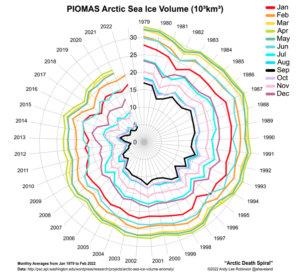
The Arctic ‘death spiral’. Note the decline in Summer sea ice volume from 17,000 km3 (1979) to 5,000 km3 (2023), and its approach to zero in around 2030 – a potentially deadly phenomenon. Source: ice volume data from Pan-Arctic Ice Ocean Modelling & Assimilation System (PIOMAS), University of Washington. Graphic by Andy Lee Robinson, used with permission.
Arctic sea ice
One acute emerging threat is that the volume of Arctic Summer sea ice has declined by over 12,000 cubic kilometres since accurate records began in 1979, and is expected to approach zero in around September 2030. Without Summer sea ice to absorb excess heat, the physical properties of ice and water mean that the temperature of the Arctic Ocean and its seabed and surrounding lands will rise much faster than before. There are two main mechanisms for this. First, that ice is white and more reflective than wate, so its declining area means that more sunlight is absorbed by the relatively dark waters of the Arctic Ocean. And second, that it takes 80 times more heat to melt ice than to warm water (334 J/g/oC for ice, but only 4 J/g/oC for water), so summer sea ice has kept the Arctic Ocean cold while excess heat has been going into warming and gradually melting ice.
The Arctic methane threat
Sudden heating after the loss of Arctic summer sea ice could have very serious consequences. First, a potentially large share of many hundreds of billions of tonnes (Gt) of peat contained within permafrosts throughout the Arctic will decay and release methane (CH4). And second, a potentially large share of the hundreds of Gt of methane contained within frozen clathrates in the shallow Arctic seabed will be released. Every tonne of methane is about 85 times more potent as a greenhouse gas (GHG) over 20 years than a tonne of carbon dioxide. Hence the release of even a small share of Arctic methane could completely undo the effect of other efforts to combat global heating. Most governments are still wrestling with the need to decarbonise economies while keeping business as usual going as strongly as possible. Hence the Arctic methane threat is not being addressed as a separate issue that could soon wreck the whole system. If it was, we would need to work out how to recapture methane from the open air, a task requiring new catalysts to make the process energetically feasible, as well as new engineering.